Product Overview
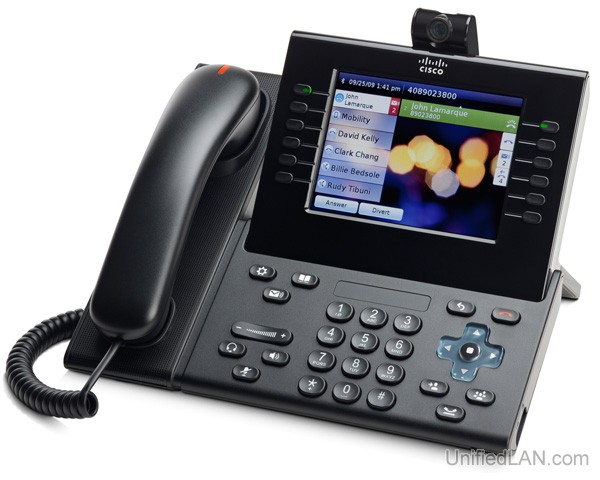
The Cisco Unified IP Phone 9951 is an executive class collaboration endpoint that provides voice, video, applications and accessories. Highlights include Gigabit Ethernet, Wideband Audio, Color Display along with a new industrial design and user interface designed for simplicity and high usability. Accessories, sold separately, include a standard definition USB camera, Jawbone ICON for Cisco Bluetooth headset, color Key Expansion Module plus support for Bluetooth, USB devices. Application support includes XML and Java Midlet capabilities.
Features and Benefits
• Newly developed industrial design and user experience designed for use with its VGA display
• H.264 video support for 2-way standard definition calling with USB support for the Cisco Unified IP Camera
• Gigabit Ethernet network connectivity and switch port available for a downstream PC
• Embedded Bluetooth radio and 2 USB ports for headsets and the camera
• Firmware support for XML and Java Midlet applications
Table 1. Features and Benefits
|
Feature |
Benefits |
|
Hardware |
|
Ergonomic Design |
Highly usable and intuitive arrangement of lines, features and calls. Transfer, Conference and Hold appear on hard keys to reduce the number of presented softkeys to a maximum of 4 per call state. |
|
Customization |
This model can be ordered as Arctic White or Charcoal Gray. Handsets are available internationally as slimline (5oz, 140g) or standard (6oz, 170g) and can be mixed and matched between users within the same work environment to enable a feeling of customization and ownership among the users. |
|
Display |
VGA presentation for calling, video calling and applications. 5-inch (10 cm) graphical TFT color display, 24-bit color depth, 640 x 480 effective pixel resolution, with backlight. Display also supports localization requiring double-byte Unicode encoding for fonts. |
|
Ethernet |
Internal 2-port Cisco Ethernet switch allows for a direct connection to a 10/100/1000 BASE-T Ethernet network through an RJ-45 interface with single LAN connectivity for both the phone and a colocated PC. System administrator can designate separate VLANs (802.1Q) for the PC and phone, providing improved security and reliability of voice and data traffic. |
|
Bluetooth |
Mobility for headset users within 30 feet of their desktop to enable the freedom to go to the printer, a colleague's desk or nearby private location while on a call. The 9951 supports the Hands-free and Headset Bluetooth profiles. |
|
USB |
2 USB ports accelerate the usability of call handling and applications by enabling accessories such as the Cisco Unified IP Camera, wired and wireless headsets. |
|
External Audio Ports |
General Purpose Audio In and Audio Out ports enable a relaxed speakerphone experience over external speakers and microphone. |
|
5 Lines Expanding to 77 with 2 Key Expansion Modules |
The convenience of many speed dials or programmable features, or the necessity of following the activity of many lines. Up to 200 calls supported per device. |
|
Buttons |
5 feature buttons with state indicating LEDs
5 call session buttons with state indicating LEDs
Applications, Directories, Voicemail
Conference, Transfer, Hold
Volume Up/Down
Back-lit Mute, Speakerphone, Headset
Back, End Call, 5-Way Navigation Pad
Arabic keypad (only available through unique SKUs. See table 5 for more details) |
|
Accessories |
|
Key Expansion Module |
Available separately, enables advanced use of lines, speed dials and features. |
|
Cisco Unified IP Camera |
Available separately, enables 2-way video calling between phones or to a media conference unit. |
|
Headset Support |
Integrated design & advanced, updateable firmware for Jawbone ICON for Cisco Bluetooth headset which also works with all major mobile phone models. Also supports standard Bluetooth and USB headsets supported via the hands-free and headset Bluetooth profiles. Wideband analog headset support also provided via a dedicated RJ9 headset port on the rear of the phone. |
|
Firmware |
|
New User Experience |
Advanced organization of lines, speed dials and programmable features separate from call appearances. Great for those who make few calls per day, better for those who handle dozens of calls per hour. |
|
SIP Signaling |
SIP interoperation with the call control and partner applications enables a rich unified communications solution. |
|
Application Support |
XML and Java Midlet applications provided by Cisco's application development partners or customers' own development staff. |
Unified Communications Manager Support
• Cisco Unified Communications Manager version 7.1(3a)SU1 or later.
– Some features require more recent version of UC Manager and Dev Pack support. Please check the release notes for more information.
• Survivable Remote Site Telephony (SRST) version 4.3 or later.
• CME 8.6 or later
Licensing
Phone licensing is dependent on the call control platform and its policies. For the Cisco Unified Communications Manager, the 9951 requires 4 Device License Units (DLUs) or an Enhanced IP User Connect License for UCM release 7.1(5) or later. There are no special licence plus phone bundles for Tier II distributors. The 9951 is not support on non-Cisco third party call control systems.
Table 3. Calling Features
|
Feature |
Specifications |
|
Calling Feature Support |
• + Dialing
• Abbreviated dialing
• Adjustable ringing and volume levels
• Adjustable display brightness
• Agent Greeting/Whisper Coaching
• Application Launch Pad
• Auto-answer
• Auto-detection of headset
• Barge
• Callback
• Call forward
• Call forward notification
• Call history lists
• Call park
• Call pickup
• Call timer
• Call waiting
• Caller ID
• Corporate directory
• Conference
• Direct transfer
• Extension mobility service
• Fast-dial service
• Forced access codes/Client matter codes
• Group call pickup
• Hold
• Intercom
• Immediate divert
• Join
• Last-number redial
• Malicious-caller ID
• Message-waiting indicator
• Meet-me conference
• Music on hold
• Mute
• Network profiles (automatic)
• On- and off-network distinctive ringing
• OPickUp
• Personal directory
• Predialing before sending
• Privacy
• Redial
• Ring tone per line appearance
• Service URL
• Shared line
• Time and date display
• Transfer
• Visual Voice Mail
• Voice Mail |
|
Audio Codec Support |
G.711a, G.711u, G.729a, G.729ab, G.722, iSAC and iLBC audio compression codecs. |
|
Configuration Options |
• Dynamic Host Configuration Protocol (DHCP) client or static configuration
• Support for online firmware upgrades using Trivial File Transfer Protocol (TFTP)
• Domain Name System (DNS)
• HTTP Firmware Management |
|
Network Features |
• Cisco Discovery Protocol (CDP)
• Link Layer Discovery Protocol Power over Ethernet (LLDP-PoE)
• Transparent secure roaming
• Provisioning of network parameters through DHCP
• Switch Auto-Negotiation
• VPN Client |
|
Security Features |
• Certificates
• Image authentication
• Device authentication
• File authentication
• Signaling authentication
• Media encryption using Secure Real-Time Protocol (SRTP)
• Signaling encryption using Transport Layer Security (TLS) Protocol
• Certificate authority proxy function (CAPF)
• Secure profiles
• Encrypted configuration files |
|
Provisioning and Manufacturing |
• Cisco Unified Communications Manager Express Version Negotiation
• Web server for configuration and statistics
• QoS reporting: jitter, delay, dropped packets, and latency on a per-call basis
• Real Time Control Protocol (RTCP) support and monitoring
• Syslog |
Table 4. Video Features and Benefits
|
Feature |
Specifications |
|
Video Standards |
H.264/AVC |
|
Frame Rates |
30 fps (maximum) using H.264/AVC for video |
|
Frame or Picture Formats |
SQCIF (128 x 96 pixels)
QCIF (176 x 144 pixels)
QVGA (320 x 240 pixels)
SIF (352 x 240 pixels)
CIF (352 x 288 pixels)
VGA (640 x 480 pixels) |